
The independent evaluation of the Sussex scheme Croydon wants to copy found a 58% drop, from eight offenders. Only 12% of Croydon shop thefts reach court.
The independent evaluation of the shoplifter tagging scheme Croydon says it wants to copy was published on 17 September. It found that eight prolific offenders fitted with GPS tags in Sussex went on to commit around 58% fewer offences. Five of the eight committed no further offences at all (Sussex Police and Crime Commissioner).
That is now the evidence base for the Croydon shoplifting pilot Executive Mayor Jason Perry announced on 11 August, when he said persistent offenders could be tagged and excluded from the town centre (Croydon Council).
It is a small study. Eight people is eight people, and the evaluation says so. The number that decides whether any of this reaches Croydon is a different one, and it is ours: of 1,527 shop thefts recorded in the two wards covering Croydon town centre and West Croydon in the year to July 2026, 12.0% are recorded as reaching court at all. A GPS tag in Sussex is a condition of a court order made after a conviction. No conviction, no tag.
Update, 19 September 2026: this page was first published on 15 August. It has been rewritten to carry the Sussex evaluation published on 17 September, the court mechanism that makes a tag possible, and our own analysis of Croydon’s recorded shop theft figures. Croydon Council has published nothing further about the pilot on its own newsroom since 14 August.
What the Sussex evaluation found
Operation STOP, the Shop Theft Offender Pilot, launched in East Sussex in summer 2025. It is led by the Sussex Police and Crime Commissioner, Katy Bourne, with Sussex Police, East Sussex County Council, the Probation Service, Change Grow Live and the Co-op. The evaluation was carried out by the Centre for Public Innovation.
Its findings, as published by the Commissioner’s office:
- all eight tagged offenders in the initial analysis reduced their offending
- five of the eight committed no further offences after being tagged
- one prolific offender has remained offence-free since October 2025
- there were roughly 11 to 13 fewer offences per person after tagging, an overall reduction of around 58%
- those who did reoffend consistently committed fewer offences than before
- on the before-and-after rates for those eight people, around 300 offences are projected to be prevented over 12 months, saving about £100,000 in police and wider criminal justice costs
Partners described “a dramatic fall” in offences and an “undeniable drop in offending”. Superintendent Michelle Palmer-Harris of Sussex Police said she was “pleased to see the success of Operation STOP in East Sussex and its continued expansion into Brighton & Hove and West Sussex”.
Bourne set out the limits herself. “We are still learning,” she said, “developing a better understanding of who engages well, where challenges arise and how we can provide the right support.” She added that the group involved “often have multiple and complex needs, so there is no one-size-fits-all solution”.
How a tag actually gets fitted
This is the part the Croydon announcement leaves out, and it is the whole mechanism.
A tag is not something a council fits. In Sussex it is a condition of a Criminal Behaviour Order, which a court can make only after a conviction for shop theft. The Commissioner’s office set out the first two when they were granted (Sussex PCC, 14 October 2025):
- the first order was granted at Brighton Magistrates’ Court on 19 September 2025, with a 12-month GPS tag and an exclusion zone around the Co-op on Albert Parade, Eastbourne
- the second was agreed at the same court on 1 October 2025, with the 12-month tagging period starting when the offender is released from an eight-month custodial sentence
- the device is a Buddi ankle tag, already used by Sussex Police for Stalking Protection Orders and for monitoring registered sex offenders
- the standard tagging period is 12 months, and a court may extend it
So the chain runs: reported theft, identified suspect, charge, conviction, application for a Criminal Behaviour Order, order granted with a tagging condition. Six links. A pilot can only ever be as big as the narrowest one.
As of the evaluation, 16 Criminal Behaviour Orders with GPS tagging conditions had been authorised in Sussex. Six people were wearing tags, with 12 further cases awaiting court hearings. The scheme expanded across the whole county in May 2026 and now has capacity for 30 tags covering East Sussex, West Sussex and Brighton & Hove.
The half of the scheme Croydon has not mentioned
Operation STOP is not only a tag. It funds a Business Crime Navigator, a role delivered by the charity Change Grow Live and co-funded by Southern Co-op, the Probation Service and East Sussex County Council. The Navigator helps people on the scheme get at housing, healthcare, substance misuse services, benefits and employment support.
The evaluation found strong support for that role among partners, who described it as a vital part of why the project works. One participant told the evaluators: “It’s nice to have someone batting for you… there is always someone in your corner.”
Croydon’s August announcement names no equivalent. It describes tags, exclusion zones and a zero-tolerance approach, and says “the funding and the enforcement of the technology is still being explored as part of the research”. On the Sussex evidence, the support side is not an optional extra bolted onto the tag. It is half of the thing being evaluated.
What happens to a Croydon shop theft now
We took the Home Office street-level crime data from data.police.uk for the 12 months to July 2026, the most recent month published, and counted every shoplifting offence recorded inside the Fairfield and Broad Green ward boundaries. Those are the two wards covering the town centre and West Croydon, including North End, Dingwall Road and the main shopping streets.
There were 1,527. This is what the police record as having happened to them.
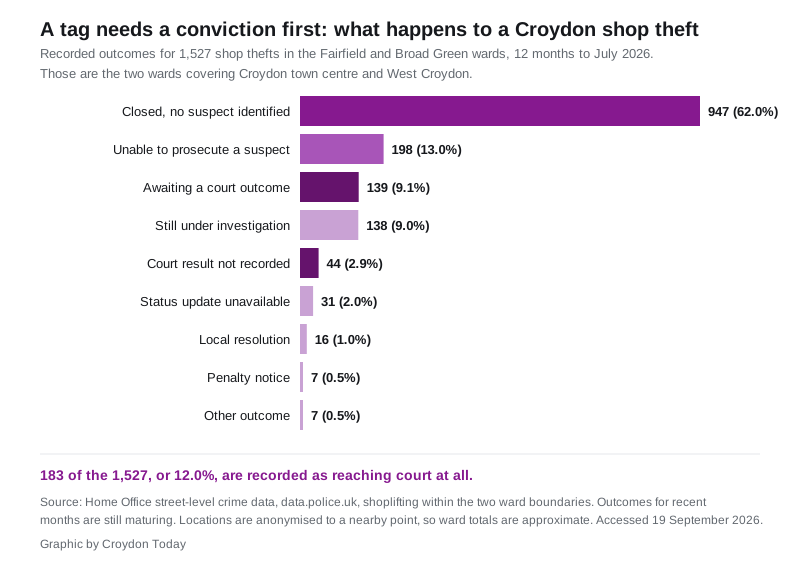
- 947, or 62.0%, closed with no suspect identified
- 198, or 13.0%, closed because a suspect could not be prosecuted
- 139 were awaiting a court outcome and a further 44 had a court result not recorded, so 183 in total, or 12.0%, are recorded as reaching court
- 138 were still under investigation
- the rest were local resolutions, penalty notices or other outcomes
Two caveats, and they matter. Outcomes for the most recent months are still maturing, so some of those 138 open investigations will move. And street-level locations are anonymised to a nearby point, so ward totals are close rather than exact.
Even allowing for both, the shape is not in doubt. The pool of people a court could tag is a fraction of the problem, because the great majority of reported shop thefts in Croydon never get as far as a named suspect.
The council’s own number, and what the police data says
The August announcement said there were “4,796 reported shop thefts in the town centre over the last 12 months and 5,043 the year before”, a fall of 4.9%.
On the same street-level data, across the whole borough of Croydon and not just the town centre, there were 3,570 shop thefts recorded in the 12 months to July 2026, against 3,704 in the 12 months before. That is a fall of 3.6%, so the direction the council describes holds up.
The size does not. The council’s town centre figure is larger than the total recorded anywhere in the borough over the same period. The announcement does not say where the 4,796 comes from or how it defines the town centre, and street-level data excludes offences that could not be tied to a location, so the two are not directly comparable. The gap is wide enough that the source is worth publishing.
There is also a trend the annual figure hides. The fall is all in the first half of the year. The most recent four months run sharply the other way:
| Four months, borough-wide | Recorded shop thefts |
|---|---|
| April to July 2025 | 1,119 |
| April to July 2026 | 1,470 |
That is a rise of 351 offences, or 31.4%. July 2026’s 419 is the highest single month since October 2024.
What it means for you
If you run a shop in the borough, keep reporting every theft individually, including the ones that feel pointless. The figures above are built entirely from those reports, and an unreported theft is invisible to the council, the police and to any future tagging scheme. The practical routes in remain the Town Centre Taskforce and the Croydon Business Association rather than this pilot, which still has no start date, no cost and no published number of offenders.
If you are a resident, nothing about the town centre has changed. What changed on 17 September is that the scheme Croydon is copying now has published evidence behind it, and that evidence is encouraging and small at the same time. Judge Croydon’s version when a date, a cost and a support offer are published alongside it.
One caution on the language, unchanged since August. Tagging and exclusion zones apply to people a court has convicted and made subject to an order. An arrest is not a conviction, and a “prolific offender” in a press release is a person the courts have to have dealt with first. We will report the Croydon scheme when there is a decision to report, not before.
For the day-to-day town centre picture, our roadworks and travel page covers current closures, parking in Croydon has the tariffs, and our planning applications page tracks what is being proposed for the shopping streets themselves.
Sources
- Sussex Police and Crime Commissioner, GPS tagging linked to significant reductions in offending among prolific shoplifters in Sussex, 17 September 2026
- Sussex Police and Crime Commissioner, Sussex secures first court orders in ground-breaking tagging pilot targeting prolific shoplifters, 14 October 2025
- Croydon Council, Zero-tolerance: Croydon plans GPS tagging crackdown on prolific shoplifters, 11 August 2026
- Home Office street-level crime and outcomes data via data.police.uk, shoplifting offences within the Fairfield and Broad Green ward boundaries and within the Croydon local authority boundary, accessed 19 September 2026. Contains public sector information licensed under the Open Government Licence v3.0
Have your say